
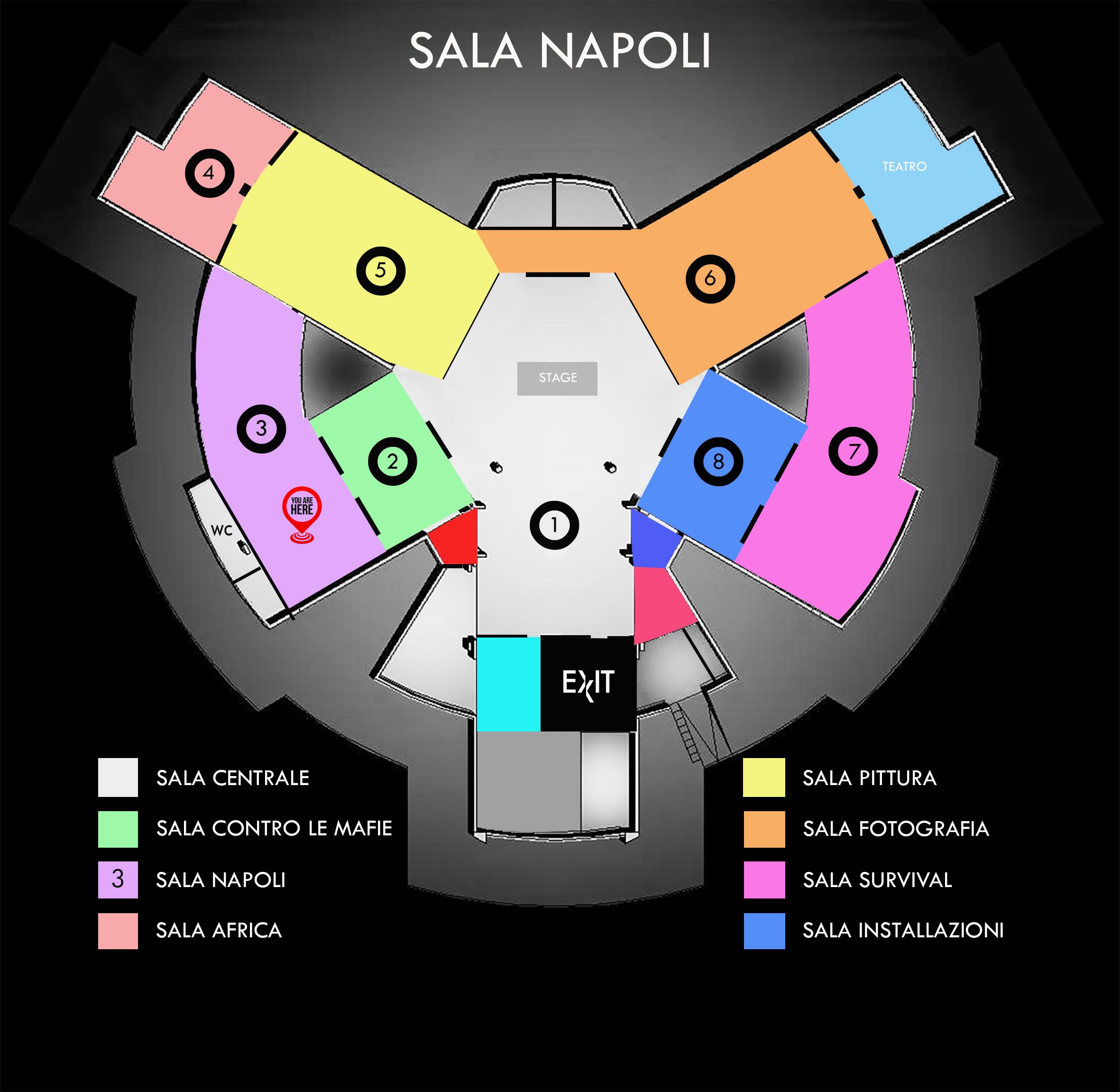
This room is dedicated to Vitaliano Corbi, an art historian who passed away in 2010. The collection housed here features works by Neapolitan artists from the post-World War II period to the present day, spanning from Informal Art to Abstract Expressionism, from the Transavantgarde to Conceptual Art. It serves as a reflection on the social context in which these artists have worked and continue to work.
Half a century of excellence and tragedy, a mosaic of environmental factors intertwined with representations that are both authentic and mundane, defines the history and contemporary reality of Naples. Pizza and the Camorra, Maradona and garbage, urban warfare and nativity street scenes, the business district and cholera, the art stations and the Scampia housing blocks: inconsistencies, contrasts, and clichés that create the stereotypical image of the city.
Overcoming these contextual barriers has been the challenge embraced by Neapolitan artists, who have drawn creative inspiration from these contradictions. Naples is not Stockholm, and “Casoria is not Milan,” but it is telling that Giorgio Gaber once began a show by saying: “You wouldn’t expect… fertile ground for individual creativity… where the dominant tone is a pervasive and unyielding gray.”
A champion of studies on Neapolitan art from the post-war period onward, Vitaliano Corbi always advocated for the value of Neapolitan creative expression, free from the constraints of the market. He devoted particular attention to the concept of the museum, which, according to Corbi, should not limit itself to hosting exhibitions but should extend its activity through systematic research, study, and documentation.